

Lamu County targets to Resettle Displaced Communities by issuing Ancestral Land Titles

In a move to end land squatting and restore ancestral lands, the Lamu County Government has embarked on a plan to resettle displaced communities by issuing collective community land title deeds.
The initiative aims to prevent land from being sold cheaply to outsiders and to protect the heritage of indigenous communities uprooted during the 1960s Shifta War.
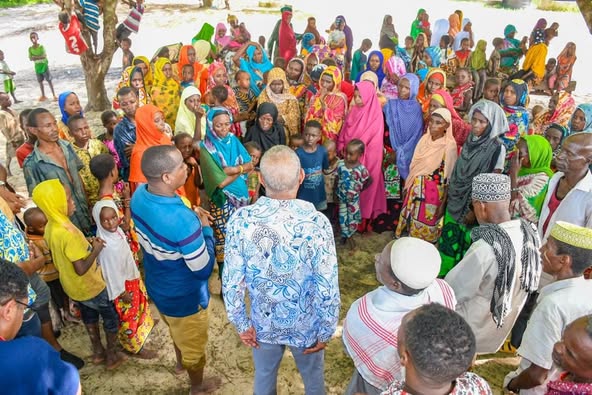
The resettlement effort was highlighted during a crucial meeting in Malindi, Kilifi County, where Lamu’s County Executive Committee Member (CECM) for Lands, Tashrifa Bakari, alongside other county leaders and representatives from the National Land Commission (NLC), engaged members of the Simambae community.
The discussion centered on embracing community land ownership and returning to Lamu, where their ancestors once lived before displacement.
The Simambae, Rubu, and Mwambore communities were among Kenya’s first internally displaced persons (IDPs) following the 1964 Shifta War, which saw more than ten villages in Lamu East sub-county dissolved. Other displaced villages include Ishakani, Kiunga, Mvundeni, Ashuwei, Matironi, Mkokoni, Vumbe, Saadani, Kiangwe, Ndhununi, and Bodhei.
Many of these displaced families have lived as squatters for decades, while their ancestral lands remained classified as public land, neither surveyed nor demarcated.
Speaking at the Nidhamia Hall meeting, Ms. Bakari stressed the importance of community land titles in preserving heritage and preventing future land dispossession.
“This project is about safeguarding the legacy of the Simambae people. By transitioning from individual title deeds to community land, we ensure that families retain their land for sustainable use rather than selling it off,” she explained.
She pointed out that in areas like Bargoni and Vumbwe, where individual titles had been issued before, many residents sold their parcels to outsiders and later found themselves landless again.
Kiunga MCA and Lamu County Assembly Majority Leader Mohamed Mbwana, whose ward includes Simambae, called the initiative a “legacy project” that not only restores land but also strengthens cultural identity.

“This is more than just a land resettlement program—it’s about dignity, identity, and future prosperity. I urge all Simambae community members to return to Lamu, reclaim their rightful home, and even register as voters so they can benefit from development,” he said.
With 90% of the titling process already completed, county officials expect the program to be finalized by the end of the year.
Once complete, the county government plans to invest in key infrastructure such as roads, water access, and facilities to support farming and community development.
Abdilahi Mbwana, a member of the Simambae community, reflected on the significance of this moment.
“Our forefathers were displaced during the Shifta War, and for decades, we have lived as landless people. Today, thanks to the Lamu County Government, we have reclaimed what is rightfully ours. This land is now secured for future generations,” he said.
